
Analyzing Competitive Bouldering’s New Scoring System

How the point-based rules change rankings and what they reward

When I say I love rock climbing, you might picture granite cliffs like El Capitan or the walls of Red Rocks. Maybe there’s a bird flying past my head. What I mostly mean is that I spend a lot of time indoors pulling on colorful plastic holds that look nothing like real rock while breathing more chalk dust than is probably good for me.
Like casual athletes in many sports, I follow the elite competition series in the US and abroad. Recently, there’s been a small amount of uproar over how bouldering (I’ll explain in a minute) competitions are scored. So I decided to look into it. What started out as a vibe-coded tool to see how changing scoring changes results has evolved into this post where I explore how those results would have been different with the previous scoring system and how maybe the current system could be tweaked to align closer to the ratio of values that best represent the discipline.
What is Bouldering?
Bouldering is a discipline of rock climbing where you climb short walls, usually 10 to 16 feet tall, without a rope and attempt to reach the top. When you're climbing outside on real rocks, the only thing that counts as a "top" is either climbing on top of the boulder then walking or jumping down, or matching two hands on the last handhold in such a fashion that you're not actively falling off. In competition, a top is always a two-handed match. There is also the concept of a "zone" in competition which is a somewhat arbitrarily chosen checkpoint for having completed a significant portion of the boulder.
Here in the US, competition climbing is governed by USA Climbing. International competitions are governed by World Climbing. After the 2024 Olympic Games in Paris, both organizations adopted a new scoring system for bouldering. Under the current rules, a top is worth 25 points, a zone is worth 10 and each unsuccessful attempt deducts 0.1 points.
Between the 2017 and 2024 seasons, competitors in each round were ranked first by number of tops, then number of zones, then fewest attempts to top, then finally fewest attempts to zone (a nice easy database sort if I’ve ever seen one). It also gives tops absolute priority. A climber with two tops always beats a climber with one top, regardless of how many other zones the second climber reaches.
The point system doesn’t work that way. One top and three additional zones are worth 55 points before attempt deductions. Two tops are worth 50. This is the part that has people arguing.
The Outrage
In June, the World Climbing Series had its annual stop in Innsbruck, Austria. Innsbruck is one of the major events of the season. Athletes who don’t compete at every stop often make a point of attending this one.
During the women’s semifinal, British climber Emma Edwards topped two of the four boulders. She had two unsuccessful attempts, giving her a score of 49.8, and finished in 11th place. Eight athletes ahead of her topped only one boulder. They also reached the zone on each of the other three, producing scores between 54.1 and 54.6.
Under the old scoring system, Emma would have moved from 11th to third and qualified for the final. Impact Route Setting posted about the result on Instagram and suggested that maybe the new scoring system was broken. It’s easy to see why the result felt wrong. One athlete completed twice as many boulders as several athletes ahead of her and still missed the final.
The arithmetic is straightforward. Two tops are worth 50 points before deductions. One top and three zones are worth 55. The current system is effectively saying that one top is worth two and a half zones.
The attempt penalty doesn’t do much to change that comparison. There’s a five-point difference between the two results, which would require a 50-attempt gap to make up. Nobody is getting 50 extra attempts during a competition round, so the result is almost entirely determined by how much the zone is worth. The attempt penalty is really there as a tie-breaker and not much else.
Retro-Scoring
Once we know the scoring system can change a result as dramatically as Emma’s, the next question is what would happen if we applied the old scoring method to the newer competitions.
Unfortunately, it’s not quite as simple as sorting the final results differently. The new scoring system suffers from some loss of precision in the final record. Under the old system, attempts to zone and attempts to top were recorded as separate pieces of data. The new final score only needs the attempts associated with the highest score reached, whether that’s a zone or a top.
Luckily for us, the online scoring system still shows the per-boulder attempt information even when it isn’t embedded in the final point total. I used that information to reconstruct the previous tops-zones-attempts ordering while keeping everything else about the competitions the same. The athletes climbed the same boulders and the same number of people advanced. I only changed the method used to rank them.
Across the dataset covering the 24/25 and 25/26 seasons so far, roughly two-thirds of athlete-round results didn’t move at all. There were 446 cases where an athlete ranked lower under the old system and 355 where an athlete ranked higher. Those numbers don’t balance because climbing allows ties. If several athletes tie for fifth, the next athlete may be ranked eighth, so rank movement isn’t perfectly zero-sum.
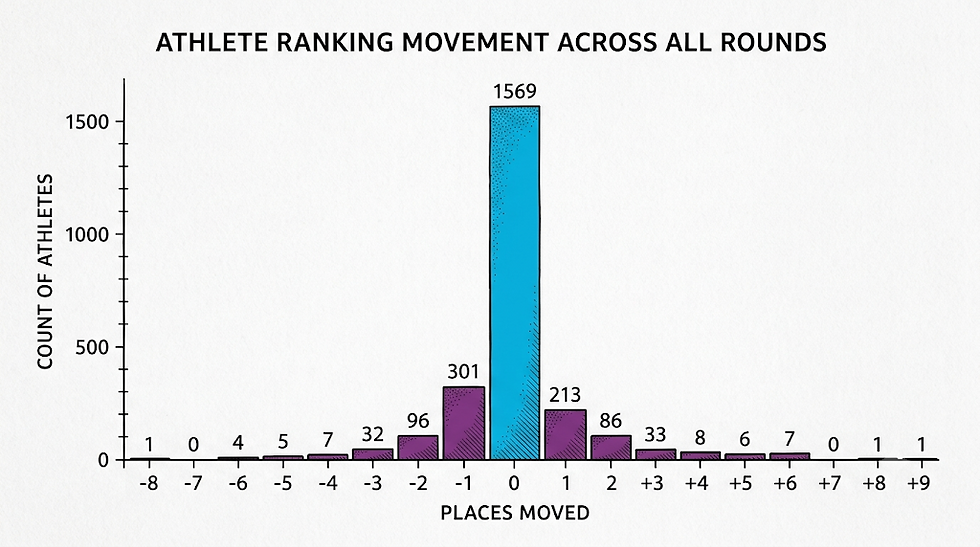
A lot of these changes aren’t especially consequential. Moving from 41st to 38th in qualification is technically a ranking change, but the semi-finals is hard-capped at the top 24. The more interesting cases are the ones that affect advancement to the next round or a place on the podium. Within those boundaries, 284 athlete results moved lower under the old rules and 216 moved higher.

The overall pattern stays about the same. The two systems usually agree, but when they disagree near a cut line, the difference can determine whether someone reaches a semifinal, makes a final, or stands on the podium.
Emma Edwards is a good example. Across the dataset, the old system would have moved her down by one place on three occasions and moved her up on three others. Five of those six changes wouldn’t have affected whether she advanced. The sixth was Innsbruck, where she moved from 11th to third.
How Much Should a Zone Be Worth?
There are a lot of points-based objective sports with scoring systems that seem intuitive. Runs in baseball are one point, while basketball and football points increase depending on the type of score. Even in darts where you’re scoring down to zero, the single, double and triple zones are done by size where a smaller area is worth a higher bonus. In bouldering, the new scoring system is somewhat arbitrary. If the goal is for two tops to beat one top and three zones, then a zone can’t be worth 10 points when a top is worth 25. Ideally, the cutoff is a little below 8.33 points. At anything higher, three zones are worth more than one top.
An eight-point zone would change the example to:
Two tops: 50 points
One top and three zones: 49 points
Eight isn’t automatically the correct value. It fixes the example that upset people, which makes it a useful starting point and a very easy way to overfit the rules to one competition. The Olympics also introduced the concept of a low-zone and a high-zone with the lower worth five. This allows for more points separation but forces boulders to be longer to accommodate the new scoring hold.
Rather than saying strictly the zone value should change or that the Olympic system should be the norm, the better analysis would calculate the results across a range of zone values for both single and dual-zone problems. For each value, we could compare the rankings with the old system, then look specifically at finalists, podiums, winners and ties. Maybe eight points preserves most of the benefits of the readable scoreboard while putting more emphasis on completing a boulder. Maybe seven works better. Maybe different rounds behave differently because qualification, semifinals and finals have different field sizes and route-setting goals.
Is the New System Broken?
I don’t think broken is quite the right word. The new scoring system was designed to be easier to understand. More points are better, which is more intuitive for a new viewer than learning a four-column ranking based on tops, zones, and attempts. It also gives athletes credit for progress across the entire round rather than only looking at completed boulders.
As someone who primarily climbs on ropes where all progress is rewarded, my preference is to keep things as they are and reward consistency. But that’s just the problem, bouldering is different and outside it’s only tops that count. Still, there’s a reasonable argument for rewarding a climber who reaches the zone on four different problems.
The data can’t tell us what competitive climbing should value. That’s a decision for the athletes, route setters, competition organizers, and probably too many committee meetings. What it can show is how often the scoring choice changes meaningful results, which types of performances benefit, and whether adjusting one number would produce rankings that better reflect what people expect when they watch the competition.
Gus Lipkin
Data Scientist
Lander Analytics
Subscribe to our Substack and below to our monthly emails for practical AI strategies for your organization: what to build, what to avoid, and how to make systems reliable in the real world.
Work with us: If you want help identifying the right first workflow, building a permissioned knowledge base, or training your team to ship responsibly, reach out at info@landeranalytics.com.
About the author: Gus Lipkin is a Data Scientist at Lander Analytics, where he writes software for data science practitioners and consumers.


